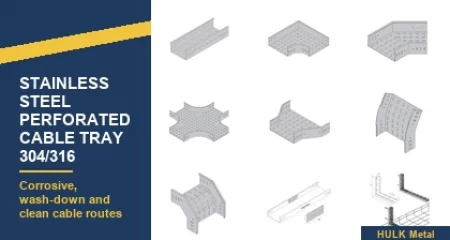
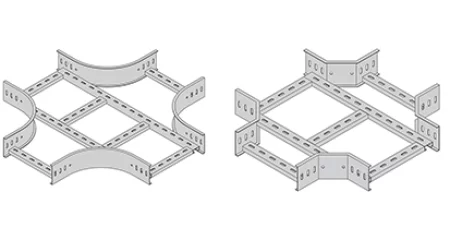
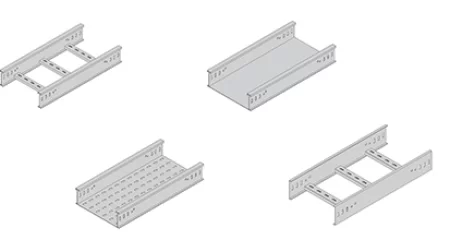
Choose 304 or project-confirmed 316L by exposure, then lock rung welding, ladder geometry, support span, route hardware and inspection evidence before quotation.

Select 304 for controlled service or 316-family stainless where chlorides are credible, with 316L written separately when the project requires the low-carbon grade.
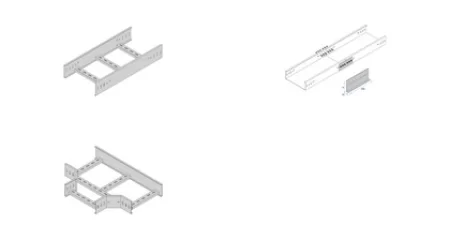
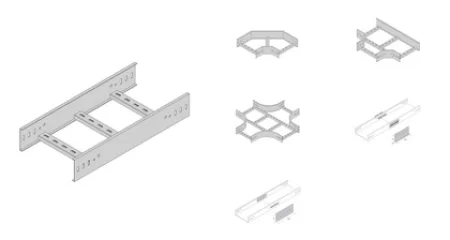
Open Welded Ladder Geometry
Side rails and rungs support heavy cable routing while preserving an open surface for heat release, drainage, inspection and access along the installed route.
Route-Matched Stainless Package
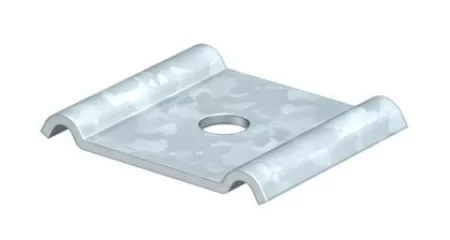
Plan fittings, splice plates, bonding parts, fasteners and support interfaces with compatible materials so the first corrosion point is not an overlooked accessory.
Project-Specific Dimensions
Source: HULK Metal company fact sheet. Widths 50-1200 mm, rail heights 10-200 mm and thicknesses 0.5-3.0 mm are quoted to approved drawings.
Traceable Quality Evidence
Raw material, weld condition, dimensions, surface and matching accessories are checked through a defined quality flow, with project-specific records available where requested.
Inquire Now
Cable Ladder System
Product Parameters and Specifications
The stainless ladder is specified by material grade, straight-section geometry and the project load case. Use the catalogue material code and finish source only for verified values; size-specific load and section-length data remain subject to project confirmation.
S4 = stainless 304; S6 = stainless 316; 316L must be stated separately and confirmed
Custom width range
50-1200 mm
Side-rail height range
10-200 mm
Sheet thickness range
0.5-3.0 mm
Rung system
Welded rungs; 300 mm is a common metric pitch, final pitch and L1-L8 profile per drawing
Load basis
DIN EN IEC 61537; size-specific SWL and span data on approved chart or test record
Tolerances
Raw material +/-0.05 mm; finished product size +/-2 mm (company fact sheet source)
Quality system
ISO 9001; project-specific material, weld, dimension and surface records available by agreement
Standard length
Contact us for details.
Matching accessories
Fittings, splice plates, bonding parts, fasteners and supports per approved schedule
This guide treats stainless steel cable ladder as a route decision. First qualify the chlorides, chemicals and cleaning cycle. Then choose 304 or an explicitly confirmed 316L grade, lock the welded geometry and support-span load basis, match fittings and fasteners to the same exposure, and define the first-article evidence before series production. The result can then be quoted and inspected against one route schedule.
When Stainless Steel Cable Ladder Is the Right Material
Stainless is the right choice when coating repair is not a practical maintenance plan and a local corrosion failure would interrupt the cable route.
That statement is narrower than “use stainless outdoors.” A dry, sheltered process area may be served by 304. A chloride-bearing atmosphere can make the same grade a poor choice even if the ladder is indoors. The material decision therefore starts with what reaches the steel, how often it stays wet, and whether deposits concentrate salts on the surface.
Controlled exposure
304 may be rational where chlorides and aggressive cleaning chemicals are absent, surfaces drain, and the specification does not depend on “stainless” to solve an unknown chemical problem.
Chloride-bearing exposure
Coastal air, marine decks, de-icing salt, chlorine-based washdown and some chemical processes call for 316 or an explicitly confirmed 316L grade.
Unresolved chemistry
If the process media or cleaner is not documented, a grade recommendation cannot be final. Obtain the chemical list and service temperature before freezing the order.
Stainless also changes the purchasing scope. A stainless straight section joined to galvanized supports and carbon-steel fasteners creates a mixed-material route with different maintenance and galvanic behaviour. The grade decision therefore belongs with the accessory schedule, not on the material column alone.
Table 1. First-pass exposure screen for a stainless cable ladder.
Route condition
Starting position
Information still required
Indoor, dry, no chlorides
304 can be considered
Cleaner chemistry, condensation, design life
Coastal or marine air
316 or confirmed 316L
Distance to surf, wetting, deposits, temperature
Chemical plant or hot washdown
Grade review, often 316L
Chemical list, concentration, temperature, cleaning cycle
If the route passes through several rooms, split the schedule by exposure rather than choosing one grade for the whole plant out of habit. A change of grade can be practical where the geometry and joint system remain controlled. Keep the comparison within the same Cable Ladder System family so joint geometry remains consistent. Send the route drawing with the environment split and we can review where that change belongs.
304 vs 316L: Chloride Exposure Is the Dividing Line
The useful difference between 304 and 316-family stainless is not appearance or general “strength”; it is resistance to local corrosion in chloride-bearing service.
Type 304 is an austenitic stainless steel with chromium and nickel but no specified molybdenum. Type 316 adds 2.0-3.0% molybdenum in the published composition range, which improves resistance to chloride pitting. Type 316L is the low-carbon version, with a maximum carbon content of 0.03% instead of 0.08%. The L designation matters most when the fabrication route includes welding and the specification is trying to reduce sensitisation risk.
Grade shorthand: molybdenum makes the 316 family more resistant to chloride pitting, and the low-carbon 316L grade is useful for welded work. Neither change makes the ladder immune to every chloride, acid or cleaner.
Molybdenum does not make 316L immune to chlorides. Published corrosion guidance notes that no stainless grade is totally immune to chloride stress corrosion cracking, and standard austenitic 304L and 316L remain susceptible. Risk rises with temperature, chloride concentration, lower pH and tensile stress. Full immersion data commonly shows SCC below 60°C to be rare, but evaporation can concentrate chlorides on a warm surface and create a much more aggressive local condition.
How to Read the Grade Decision
Coastal air: specify 316 or an explicitly confirmed 316L, then define the wetting and cleaning regime. Salt that deposits and dries repeatedly is a different exposure from salt that remains diluted and washed away.
Use compatible fasteners and check sheltered pockets where salt can collect.
Chemical or washdown service: give the chemical, concentration and temperature. A chlorine-based cleaner, acid spill or hot caustic wash can rule out a grade that looks acceptable under a generic “corrosive” label.
Welds, crevices and residues require a separate review.
Controlled indoor service: 304 can be the rational grade where chlorides and aggressive cleaners are absent. Condensation and cleaning still matter; “indoors” is not a chemical specification.
Document the exposure so the grade choice can be checked later.
Table 2. What changes between the stainless grades and what does not.
Decision point
304 / S4
316 / S6
316L requirement
Chloride pitting
Moderate; controlled exposure only
Better through Mo addition
Same 316-family benefit, not immunity
Catalogue code
S4 = stainless 304
S6 = stainless 316
Write 316L as a separate requirement
Carbon maximum
Not the basis for 316L substitution
0.08% for type 316
0.03%
Visual identification
Not reliable
Not reliable
Not reliable; use material evidence
Load rating
By geometry and span
Grade warning: HULK Metal catalogue code S6 identifies stainless 316. A project that requires 316L must state 316L in the drawing and RFQ as its own grade requirement, then confirm that grade for the exact ladder family and size. Do not treat the letter L as an automatic catalogue default.
Grade cannot be confirmed by colour or a spark test on the finished ladder. Ask for the material certificate and define the verification method in the purchase order. Where the project calls for independent composition checking, HULK Metal can inspect the incoming material with a spectrometer. Send the exact grade and acceptance requirement with the drawing so the material and inspection route are quoted together.
What Welded Rungs and Side Rails Demand from Stainless Fabrication
A stainless ladder rarely fails first in a clean, flat area; the vulnerable points are usually rung welds, crevices, contaminated surfaces and untreated field work.
The ladder geometry is open. Side rails carry the section, rungs create the cable fixing grid and welded connections transfer load between them. In stainless work, the same weld that carries load also changes the local surface condition. Heat tint, residual scale, spatter, incomplete shielding and trapped contamination can reduce the passive film exactly where water and chlorides collect.
The fabrication procedure therefore matters as much as the mill certificate. The stainless area and tools must be isolated from carbon-steel work, the filler and shielding must suit the grade, and the post-weld finish must be defined where a clean or aggressive service demands more than a wire-brushed mill finish. A carbon-steel brush can embed iron particles that begin to rust while the surrounding stainless remains bright.
Rust appears beside a rung weld
Look for embedded iron, carbon-steel tooling, grinding dust or incomplete cleaning after fabrication. The control is segregated stainless handling, dedicated consumables and a defined cleaning/passivation step before packing.
Corrosion starts in a crevice or under a deposit
Poor access, overlapping parts and unremoved weld scale trap moisture. Define a geometry that can be cleaned, remove scale after welding, and inspect the accessible surfaces before any cover or accessory hides them.
A rung looks sound but the joint fails under load
Surface appearance cannot prove penetration. Specify the welding process, qualified procedure and batch inspection method. For critical work, require sample destructive testing or the connection test evidence stated in the approved quality plan.
The first bolts rust before the ladder
Check the fastener grade. A carbon-steel or lower-alloy fastener in a stainless route can become the first corrosion site. Require compatible fasteners to be listed in the same approved material schedule.
For a chemical or high-hygiene route, the drawing should also state whether welds are pickled and passivated, what surface finish is accepted, and which inspection points cannot be covered by later assembly. Send the service environment and the weld-exposure requirement together; welding procedure and corrosion finish need to be reviewed as one package.
Straight-Section Geometry, Rung Pitch and Load Basis
Stainless 316L does not have a universal load rating, and a stainless page should not hide that fact behind a material claim.
The load case is fixed by the tray width, side-rail height, sheet thickness, rung pitch and support arrangement. According to the HULK Metal company fact sheet, ladder drawings cover widths of 50-1200 mm, side-rail heights of 10-200 mm and thicknesses of 0.5-3.0 mm. Standard metric ladder practice commonly uses a 300 mm rung pitch, but the drawing controls the final value.
The smallest and most flexible cable on the route often sets the rung pitch, not the largest cable. A closer pitch supports small cables and gives more points for cleats and ties. It also adds rungs and welds, so the selected pitch should answer a cable-support or fixing requirement rather than following a default without review.
Table 3. Inputs that must be fixed before a stainless straight-section load can be quoted.
Input
Why it changes the result
What to put in the RFQ
Width
Changes fill area and span of the cable load
Required width in mm, with quantity
Side-rail height
Changes bending strength and cable containment
Required H, not “standard”
Sheet thickness
Changes capacity at the same outer shape
Nominal thickness and tolerance requirement
Rung pitch and style
Controls cable support, fixing points and weld count
Pitch, holed/plain/Z profile, fitting continuity
Support span
The load chart is meaningless without it
Span, end span, deflection and safety factor
Cable load
The section must carry the installed cable schedule
Distributed load and concentrated loads
Use the published load basis. HULK Metal states its cable-tray and cable-ladder load ratings against DIN EN IEC 61537. Quote the support span and the governing deflection rule alongside the load value, because a number without those conditions cannot be compared with another supplier’s chart.
Do not infer capacity. A material change from carbon steel to stainless does not automatically produce a higher rating, and a stainless section should not inherit a value from a different width, height or gauge.
Size-specific load rule: if the required stainless size and span fall outside the available load chart, use “Contact us for details” rather than borrowing a number from a smaller or adjacent section. Send the cable schedule, support drawing and acceptance span so the size-specific answer can be confirmed.
Build a Route-Wide Stainless Package
A stainless straight section is not a stainless route until the fittings, joints, fasteners, bonding parts and supports are compatible with the same exposure.
The first maintenance failure after installation is often not the side rail; it is a lower-grade splice plate, a galvanized support in a wet chloride zone or a fastener that was not included in the grade review. Those parts create galvanic couples, inconsistent service intervals and a mixed bill of materials that is difficult to replace correctly.
HULK Metal can quote the ladder and fitting family under one material schedule. The practical rule is to mark every line item with the same grade family unless an engineered transition is explicitly accepted. The interface between the stainless route and the building steel must be shown on the support or bonding drawing.
Table 4. Route package check for a stainless cable ladder.
Line item
Main risk if omitted
Specify
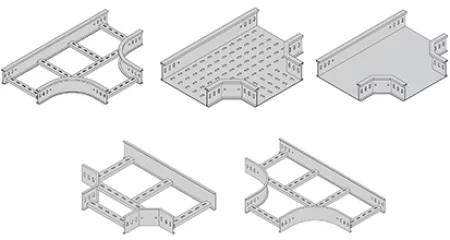
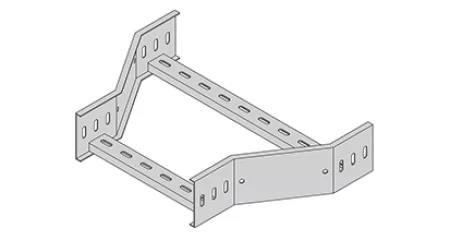
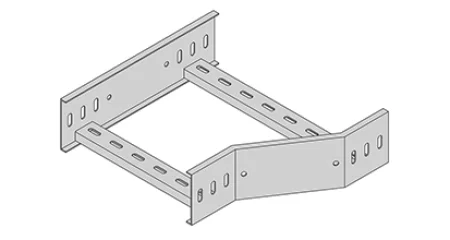
Elbows, tees and reducers
Unmatched grade becomes first corrosion point
Grade, radius, rung pattern, load class
Splice plates and couplers
Dissimilar metal and discontinuity at the joint
Material, hole fit, bolt grade, continuity
Bonding jumpers
A moving or coated joint interrupts the electrical path
Termination material and joint coverage
Fasteners
Carbon or lower-alloy bolts rust first
Matching/stated grade, coating, thread control
Supports and brackets
Stainless tray on bare galvanized steel can form a galvanic couple
Material or engineered isolation/mounting detail
Covers, dividers and clips
Intermittent contact and trapped moisture
Grade, fit, drainage and access
Compatibility is a drawing issue. If a project must use galvanized support steel, show the contact detail and approved isolation or connection method. “Stainless ladder” in the material column does not answer that interface.
Submit one schedule: send the complete straight-section and accessory list in one RFQ. We can review the material-code set and flag a mixed route before production, while a change is still a drawing change rather than a shipment correction.
Install for Drainage, Movement and Field-Cut Control
Most stainless corrosion complaints are installation details: trapped water, embedded iron, untreated cuts and supports that stop the route from moving.
The ladder should drain. A rung or side-rail detail that holds water and debris defeats the purpose of an open ladder. Pipework, roof leaks, washdown spray and condensation should be considered when the route elevation and support axis are set, because a drain-friendly section can still collect water in the wrong orientation.
Long runs also move with temperature. Provide fixed points and sliding or guided supports according to the approved installation detail, and bridge expansion joints with bonding continuity. A support that clamps every section rigidly leaves the expansion somewhere else, often at a splice plate or anchor.
1
Protect the grade before the first cut
Use dedicated stainless cutting and brushing tools. Keep carbon-steel grinding dust and wire-brush residue away from the stainless ladder.
2
Set the cut plan before delivery
Put field cuts in the layout, not wherever installation happens to stop. Cut ends should be dressed and protected according to the approved procedure.
3
Control drilled holes and swarf
Remove chips from rungs and joints, deburr the cut edge and clean the area before covers or accessories hide it.
4
Allow thermal movement
Use the approved fixed/guide support arrangement and keep the expansion gap clear through installation.
5
Prove the electrical path
Inspect bonding across splices and moving joints. An expansion gap that separates the metal path also needs a bridge if continuity is part of the design.
Table 5. Field symptoms and the installation detail that prevents them.
Symptom
Likely detail
Control
Rust spots after site work
Carbon tool or grinding dust
Segregated tools, cleaning and inspection
Staining at a cut end
Untreated field cut
Planned cut, dressing and finish procedure
Loose or pulled splice
Rigid restraint across expansion
Fixed/guide supports and clear expansion gap
Poor bonding
Coating, gap or missing jumper
Continuity detail and acceptance check
Installation input: provide the support layout, field-cut requirements and approved cleaner with the order. The installation plan can then call out where stainless tools, temporary covers and post-install inspection are required.
First Article and Incoming Inspection for Stainless Ladder
The first stainless ladder should prove material, weld condition, geometry and accessory compatibility before the series is released.
A first-article review is more than measuring the outside width. It links the material certificate to the part, checks the rung grid and diagonal, confirms the welds and surface treatment, and verifies that the planned fasteners and fittings match the approved grade. It is also the point to stop a drawing error before it repeats through the batch.
First-article release checks
0 of 6 checked
Table 6. Acceptance record for the first stainless ladder.
Check
Acceptance evidence
Release action
Material
Certificate and part-code trace
Hold if grade path is ambiguous
Rung connection
Visual and specified weld records
Repair under approved procedure
Dimensions
Measured width, height, pitch and diagonal
Compare with +/-2 mm product tolerance (company fact sheet source)
Surface
Photographic record of weld and cut condition
Clean, dress or passivate before packing
Accessories
Approved grade schedule
Replace mismatched hardware
HULK Metal’s quality flow covers raw-material verification, production inspection and finished-product checks, with spectrometers, a CMM, hardness and roughness testers, coating thickness gauges, salt-spray chambers and metallographic microscopes. Put the exact acceptance requirements in the order so the relevant records are prepared for the batch.
Factory Insider: What We Control Before a Stainless Ladder Ships
On our production floor, stainless control starts before the first strip is cut and continues after the final weld has cooled.
We treat the material grade as a traceable requirement, not a colour on a drawing. The incoming material and the order code must agree, and where the project requires composition verification, the spectrometer result belongs with the batch record. A finished ladder that looks bright cannot prove its grade.
We keep stainless work separate
Carbon-steel particles from a shared brush, grinding disc or workbench can contaminate stainless and create a rust point. Dedicated stainless handling and tooling are part of the process control.
We check the joint, not only the outline
Rung-to-rail welds are reviewed before the ladders are packed. The rung spacing, diagonal and profile must remain consistent across the batch, because a visible defect is not the only way a ladder fails.
We define the post-weld finish
When the service needs a cleaner weld surface, we work to the approved pickling, passivation or surface requirement before packing. We do not present a decorative clean-up as proof of corrosion performance.
That is why the RFQ needs the exposure and inspection standard, not only the words “stainless ladder.” Once grade, weld finish and accessory material are fixed, the shop can build the same condition into the first article and the production record.
Stainless Ladder RFQ: What Prevents a Costly Change Order
A stainless ladder RFQ becomes comparable only when the environment, grade, geometry, span, accessories and acceptance records are visible on the same page.
Separate the standard catalogue choices from the project-specific requirement. State `S4 = 304` or `S6 = 316` when using HULK’s material codes. If the project asks for 316L, write `316L` as an independent grade instruction and ask for availability for the specific ladder size, finish and welding process.
RFQ data that changes the quotation
Exposure: installed location, salt/chloride source, chemical list, temperature and washdown cycle.
Material: 304 or 316 family; 316L separately if required; material-certificate and verification requirements.
Load: cable schedule, support span, end span, deflection limit and safety factor.
Route package: fittings, splice plates, bonding, fasteners, support interface and thermal-movement detail.
Acceptance: weld finish, passivation, dimensional record, first article, packaging separation and any salt-spray requirement.
Do not hide the 316L question in a note such as “stainless only.” It changes the mill requirement, welding control and potentially the price. A clear grade instruction also prevents an order from being manufactured to a general 316 code when the drawing intended low-carbon 316L.
Useful closing line for the RFQ: “Provide the stainless straight ladder, fittings, splice plates, bonding components and fasteners as one material-compatible package. State the exact grade, size, rung pitch, support span, weld finish and inspection records that will be supplied.”
Send the drawing, cable schedule and exposure note for a size-specific review. Where the load or chemical exposure is not yet resolved, HULK Metal can quote the geometry while the missing acceptance data remains clearly marked for project confirmation.
Frequently Asked Questions About Stainless Steel Cable Ladder
The same grade name can lead to different answers once the route, welds and support conditions are considered.
Is 304 stainless steel cable ladder suitable outdoors?
Sometimes. 304 can work in mild outdoor conditions without meaningful chloride exposure, but coastal air, marine spray and de-icing salt are different. Use 316 or confirm 316L when chlorides can reach the ladder.
Is 316L immune to chloride corrosion?
No. Molybdenum improves resistance to chloride pitting, but published guidance still lists 316L as susceptible to chloride stress corrosion cracking. Temperature, concentration, pH, deposits and stress all matter.
Can a stainless route use two grades?
It can be considered when the exposure changes along the run, but the transition must be drawn and the fitting, fastener and support grades must remain compatible. A mixed grade without a schedule is difficult to inspect and maintain.
Do welded stainless ladders need passivation?
It depends on the service and the weld finish. Heat tint, scale and contamination can reduce passive-film performance, so aggressive or clean-service projects should specify cleaning, pickling or passivation as required by the approved procedure.
What controls the load rating?
Width, rail height, sheet thickness, rung pattern, support span, end-span assumption, deflection limit and the applicable DIN EN IEC 61537 test basis. A grade name alone does not provide a capacity.
Can I confirm 304 or 316 without a certificate?
Appearance is not a reliable test. Use the material certificate and agree on a verification method such as spectrometer checking where the project requires it.
Quality Control: What We Test and How
Stainless quality is controlled through material identity, weld condition, dimensions, load basis and surface records rather than a final visual check alone.
HULK Metal’s quality flow covers raw-material verification, production inspection and finished-product checks. The inspection plan can include the material grade, rung connections, dimensions, surface condition and the agreed project evidence.
Raw Material Inspection
The material grade and certificate are checked against the order. Where required, incoming stainless can be verified with a spectrometer, and the traceable result is kept with the batch record.
Production Inspection
Side rails, rung pitch, welding condition and material handling are checked during fabrication. The first piece establishes the drawing reference, and later parts are compared with it. Stainless tools and work areas are controlled to reduce carbon-steel particles, grinding dust and embedded iron before final surface inspection.
Dimension Inspection
According to the HULK Metal company fact sheet, product-size tolerance is +/-2 mm and incoming sheet-thickness tolerance is +/-0.05 mm. Width, rail height, thickness, rung pitch, diagonal and straightness are compared with the drawing and approved first article. The measurement plan identifies which values are recorded for the shipment.
Load Testing
The applicable cable-ladder product is checked against the DIN EN IEC 61537 load basis and approved support/span conditions. A size-specific result or test record is supplied only for the configuration that was assessed.
Surface Inspection
The inspector looks for weld scale, heat tint, embedded iron, handling marks, burrs, swarf and visible contamination. The agreed cleaning or passivation requirement is checked before covers or packaging hide the surfaces.
Finished Product Inspection
The finished ladder is checked against the approved first article and route schedule. Splice plates, fasteners, bonding parts and fittings must match the grade and quantity listed for the shipment.
Packaging Inspection
Stainless sections are separated from carbon-steel handling and protected against abrasion, moisture and contamination. Identification, quantity, material code and accessory grouping are checked before the package is released. The outer protection must remain intact during loading and transit so the inspected surface arrives in the same condition.
Article Navigation
Factory & Workshops
HULK Metal plans stainless ladder work around material control, dedicated handling, welding discipline and final inspection. The production and inspection route can be tied to the approved drawing and project records.
HULK Metal combines stainless ladder fabrication, accessory planning and inspection evidence under one procurement route. The value is not a lower unit price alone; it is a complete, checkable package that reduces rework after delivery.
One Stop Purchase
Get Higher Quality
Get Faster
Save More Money
Save More Time and Energy
Straight sections, bends, reducers, splice plates, bonding parts, fasteners and supports can be reviewed as one route package. One responsible supplier reduces the risk of receiving components in different grades or finishes that do not fit the same installation. A single line-item schedule also makes it easier to compare the quotation and receiving records, and fewer suppliers have to be coordinated after a grade change.
Material verification, production checks and finished-part inspection are supported by the factory quality system. For stainless work, the review can include grade evidence, weld condition, dimensions and the agreed cleaning or passivation requirement before shipment. These records give purchasing and engineering a common basis for acceptance and make a later batch comparison more practical after every approved first release with traceable quality records.
Early RFQ input allows drawings, material schedules and accessory requirements to be reviewed together. When each size is clearly identified, the quotation and first-article review avoid repeated clarification and shop rework caused by unknown grade or geometry. A clean first article then supports a faster series release, with fewer changes crossing into cutting and welding without reopening the material decision.
Choosing the right stainless grade for the actual exposure avoids paying for unnecessary alloy while protecting the route where chlorides are real. Matching accessories and planning field cuts also reduce replacement hardware, delayed installation and premature maintenance. The lowest useful total cost follows the required service condition and a clear first-article acceptance plan, not the lowest alloy price alone or an unverified substitution.
A complete drawing and inspection plan gives purchasing, engineering and receiving one shared reference. The team can compare the quotation, first article and delivered package against the same material, dimension, load and surface requirements. Fewer late questions reduce the effort needed to prove that the shipment matches the approved route and its required accessories after delivery and during final handover.
Compatible Cable Ladder System Products
These product pages help compare the stainless owner with the generic straight-section, hot-dip galvanized, pre-galvanized, cover and fixing options. Use the comparison to keep material ownership clear rather than substituting one finish for another. A project can then combine straight sections, protection and restraint without losing the stainless grade requirement. Select each link by function first, then confirm the material or finish code on the drawing.
Cable Ladder Load, Fitting and Installation Guides
Use these guides to connect the stainless material decision to the rest of the cable ladder system. They cover fitting load-class alignment, incoming inspection, riser restraint and published size/load-table reading. Together they help a buyer check welds, joints, support loads and cable restraint instead of treating the straight section as an isolated purchase. They also show which checks continue after material selection.